Learn how better visibility into production activity, postage spend, address quality, communication workflows, and file activity can help organizations uncover trends, identify issues earlier, and turn communication data into actionable business insights that support smarter decisions.


.png)


For organizations sending critical communications, getting a message out the door is only part of the job.
What happened after the file was submitted? How much mail was produced? Are volumes trending differently than expected? What did postage actually cost? How clean was the address data? Who accessed a sensitive file, and when?
When that information lives across disconnected systems, spreadsheets, reports, and vendor portals, answering seemingly simple questions can become surprisingly difficult.
That is why visibility matters.
Better visibility into communication operations gives organizations the information they need to identify trends earlier, investigate exceptions faster, understand costs more clearly, and make more informed decisions about the communications they send.
CompuIntelligence® helps bring that information together by providing centralized visibility into communication workflows, production processes, postage, address quality, file activity, and operational events.
Visibility Is More Than Tracking
Visibility is sometimes treated as synonymous with tracking.
Tracking is important, but true operational visibility goes much further.
It means understanding the entire communication lifecycle—from the data and files entering a workflow through review, production, postage, address quality, operational status, and the secure exchange of information.
Instead of asking only, “Where is the communication?”, organizations can begin asking:
Are communications progressing as expected? What trends are developing? Where are we spending money? Where are data-quality problems occurring? Are approvals creating bottlenecks? And can we quickly determine what happened when questions arise?
Those questions turn visibility into actionable intelligence.
CompuIntelligence® approaches visibility from several different perspectives through purpose-built modules designed around different parts of the communication lifecycle.
1. Understand What Is Happening Across Your Communication Workflow
A communication program can generate an enormous amount of operational information: files received, jobs processed, pieces produced, production dates, volumes, exceptions, and service-level performance.
The challenge usually isn't whether the data exists. It's whether teams can easily use it.
Consider a monthly statement program that normally produces 500,000 pieces. If volume unexpectedly drops to 425,000, how quickly would someone notice?
Or imagine a time-sensitive communication that normally progresses through production within a predictable timeframe. Would your team recognize an unusual delay before someone called to ask about it?
This is where dashboards, trend reporting, job status, and production milestones can become more valuable than static reports.
Track IQ, within CompuIntelligence®, provides visibility into communication activity and production workflows. Teams can monitor communication volumes, track job status, review production milestones, analyze trends, and evaluate service-level performance.
Rather than simply documenting what happened at the end of the month, organizations can use that visibility to establish normal patterns and identify when something falls outside them.
Useful questions include:
- Are communication volumes consistent with historical trends?
- Are jobs progressing through expected production milestones?
- Are certain programs experiencing recurring delays or exceptions?
- Are service levels changing over time?
- Are there unusual spikes or drops that deserve investigation?
The goal isn't simply to collect more data.
It's to make important activity, trends, and exceptions easier to see.
2. Turn Postage From an Expense Into an Insight
Postage is one of the largest variable costs associated with physical communications, yet organizations may only see it as a line item on an invoice or monthly financial report.
Greater postage visibility can provide a much more useful picture.
USPS mailing prices have continued to change. In July 2025, USPS increased Mailing Services prices by approximately 7.4%. Another change took effect in July 2026, including an increase in the price of a one-ounce First-Class Mail stamp from $0.78 to $0.82.
In that environment, understanding postage at a more granular level becomes increasingly important.
Postage Vision, within CompuIntelligence®, provides detailed postage reporting and spend analysis so organizations can gain greater visibility into mailing expenses, budgeting, and operational accountability.
Instead of seeing only a total postage expense, teams can begin examining how mailing costs change over time and where those dollars are being spent.
Useful questions include:
- How is postage spend trending month over month?
- Which communication programs account for the largest share of spend?
- Did postage increase because volume increased, or did cost per piece change?
- Are actual mailing expenses aligning with forecasts?
- Where should future budgeting assumptions be adjusted?
This shifts postage reporting from simply explaining what was spent to helping understand why it was spent.
That additional context can make postage information more useful for finance, operations, forecasting, and client reporting.
3. Use Address Quality as a Performance Metric
A communication can't accomplish its purpose if it never reaches the intended recipient.
Address quality is therefore more than a production concern. It is an important indicator of the overall health of a communication program.
USPS maintains an extensive set of address-quality tools, including Coding Accuracy Support System (CASS™), Address Element Correction (AEC), and National Change of Address (NCOA) solutions.
For organizations, the important step is moving beyond simply performing address hygiene and beginning to measure it.
Performance Pulse, within CompuIntelligence®, provides address hygiene reporting that helps organizations better understand the quality of their mailing data.
By providing visibility into CASS, AEC, NCOA, and other address-validation and correction information, Performance Pulse can help teams recognize patterns that may otherwise remain hidden within individual mailing jobs.
For example, organizations can begin asking:
- What percentage of addresses required correction?
- How many records matched a change-of-address record?
- Are address-quality issues concentrated within a particular portfolio, client, or data source?
- Are correction rates improving or deteriorating over time?
- Are recurring problems pointing to an upstream data-quality issue?
A single address correction solves a single problem.
A trend can reveal a process problem.
If one business unit consistently produces a higher percentage of address corrections than another, the solution may not simply be another mailing workflow adjustment. It may indicate an opportunity to improve how customer information is originally collected or maintained.
Visibility turns address hygiene from a processing step into business intelligence.
4. Bring Visibility to Review and Approval Workflows
Not every communication delay happens in production.
Before a communication can be produced, it may need to move through internal or external review and approval processes.
Those workflows can become difficult to manage when approvals happen through email chains, spreadsheets, shared documents, or disconnected systems.
Questions quickly arise:
Who has reviewed the communication?
What is still waiting for approval?
Was something rejected?
What needs to be changed?
Where is the bottleneck?
Review IQ, within CompuIntelligence®, helps automate review and approval workflows so organizations can gain greater visibility into this part of the communication lifecycle.
By creating a more centralized process for review activity, teams can better understand where communications stand, reduce manual coordination, improve accuracy, and move approved communications toward production more efficiently.
This type of visibility is particularly valuable when communications involve multiple stakeholders or compliance requirements.
Instead of relying on individual emails or conversations to determine status, teams can work from a clearer record of the review process.
5. Make File Activity Part of the Audit Trail
Visibility also matters before a communication ever reaches production.
Organizations routinely exchange files containing sensitive consumer, financial, healthcare, or account information. Secure transfer methods are essential, but security doesn't end with encryption.
Organizations should also be able to understand what happened to those files.
Who uploaded a file?
When was it downloaded?
Was it subsequently deleted?
Can that activity be reconstructed months later if an auditor, customer, security team, or compliance department asks?
NIST cybersecurity guidance emphasizes the importance of event logging and audit records, including information about what occurred, when it occurred, the source and outcome of an event, and the identities associated with it.
That makes file-transfer visibility valuable for more than IT.
Trust Pulse, within CompuIntelligence®, provides visibility into secure file-transfer activity by tracking uploaded, downloaded, and deleted files.
Users can search activity by date range and export audit logs, creating a more accessible record that can support compliance, reporting, operational transparency, and investigation.
Instead of relying on emails, screenshots, or individual recollection, teams have a clearer way to understand how files moved between users and systems.
6. Improve Visibility Into Operational Events
Operational visibility isn't limited to individual jobs or reports.
Organizations also need to know when an event may affect their communication operations.
A service interruption, production event, or other operational issue can create questions across multiple teams:
What happened?
Who is affected?
Has the issue been resolved?
Is there anything we need to do?
Status IQ, within CompuIntelligence®, provides real-time operational visibility through incident tracking and alert notifications.
By keeping stakeholders informed of production events, service interruptions, and operational updates, Status Pulse helps reduce the information gap that can occur when teams are waiting for updates from different people or systems.
That visibility can improve communication and response times while giving stakeholders a clearer understanding of current operational conditions.
From Reporting to Decision-Making
The common thread across production activity, postage, address quality, review workflows, file exchange, and operational events is that visibility creates context.
A dashboard by itself doesn't improve a communication program.
Neither does a report.
The value comes from what teams do with the information.
When communication data becomes easier to access and interpret, organizations can begin moving from reactive questions to proactive management.
Instead of: “Why was postage so high last month?”
Ask: “Which programs are driving our postage trend, and is the cost per piece changing?”
Instead of: “Why did we receive so much returned mail?”
Ask: “What were our address-quality indicators before the mailing, and are we seeing a recurring trend?”
Instead of: “Is that job finished?”
Ask: “Which communications are progressing normally, and which ones are outside their expected pattern?”
Instead of: “Who still needs to approve this?”
Ask: “Where is the communication in the review workflow, and what action is still required?”
Instead of: “Did that file get downloaded?”
Ask: “Can we quickly review the activity history associated with that file?”
Instead of: “What is happening with this operational issue?”
Ask: “Can stakeholders see the current status and relevant updates?”
That is the difference between having data and having visibility.
Building a More Visible Communication Strategy
Organizations don't need to measure everything simply because the data is available.
A better starting point is identifying the questions that matter most to the business.
Consider establishing visibility across several areas:
Operational performance: communication volumes, job status, production milestones, trends, and service levels.
Cost: postage spend, cost-per-piece trends, budgeting, and mailing expense analysis.
Data quality: CASS, AEC, NCOA, corrections, and other address-quality indicators.
Workflow: review activity, approvals, rejections, and communication readiness.
Governance: secure file-transfer activity, audit history, and user activity.
Operational awareness: incidents, service interruptions, production events, and stakeholder notifications.
Then determine who needs access to each type of information and how frequently they need it.
Operations may need daily visibility into jobs and milestones.
Finance may benefit from postage trends.
Client-service teams may use performance information during business reviews.
Compliance teams may need review histories and file activity.
Leadership may want a broader view of trends and operational performance.
The objective is not another report to review.
It is creating a shared, reliable view of communication activity that helps different teams make better decisions.
Turning Visibility Into Intelligence
As communication environments become more complex, organizations have access to more operational data than ever before.
The challenge is making that data useful.
That is the role of CompuIntelligence®.
Rather than approaching visibility as a single dashboard or metric, CompuIntelligence® provides multiple perspectives into the communication lifecycle through purpose-built modules.
Track IQ provides visibility into communication activity, production workflows, volumes, milestones, trends, and service-level performance.
Postage Vision provides insight into mailing expenses and postage trends.
Performance Pulse provides visibility into address hygiene and data-quality indicators.
Review IQ brings greater transparency and control to communication review and approval workflows.
Trust Pulse provides visibility into secure file-transfer activity and audit history.
Status IQ helps keep stakeholders informed about operational events, incidents, and service interruptions.
Together, those capabilities help organizations move beyond simply collecting communication data and toward understanding what that data is telling them.
That might mean identifying a production anomaly before it becomes a larger issue.
It might mean finding an address-quality trend that is contributing to unnecessary mail.
It might mean understanding the source of a postage increase.
It might mean identifying where a communication is sitting in an approval process.
Or it might mean answering an operational, client, or audit question without searching through emails and spreadsheets.
Visibility doesn't eliminate every communication challenge.
But it makes those challenges much harder to hide.
And moving from blind spots to insights is often the first step toward a more efficient, accountable, and informed communication strategy.
Turn Visibility Into Action
Better decisions start with better visibility.
CompuIntelligence® brings communication data together across the lifecycle through Review IQ, Track IQ, Postage Vision, Performance Pulse, Status IQ, and Trust Pulse—helping organizations gain greater transparency into workflows, production activity, postage, address quality, secure file exchange, and operational events.
The result isn't simply more data.
It's a clearer view of what's happening, why it matters, and where your team may need to take action.
See how CompuIntelligence® can help turn your communication data into actionable insight.
Latest insights from our articles
Explore a collection of curated articles designed to help you stay ahead in multichannel communication, compliance, and digital transformation.
From Blind Spots to Insights: Why Visibility Matters!
.png)
What Could You Do With 27% More Space on Your Mailpiece?
Moving from letter-size to legal-size paper creates approximately 27% more content area—opening new opportunities for calls to action, QR codes, regulatory content, and smarter document design.
.png)
Security Isn't a Feature. It's the Foundation.
Whether it's a billing statement, healthcare notice, collection letter, or account notification, organizations are responsible for protecting sensitive consumer information at every stage of the communication lifecycle. That responsibility extends far beyond simply delivering a document.
.png)
A Gold Glove Customer Experience: Precision, Partnership, and Proactive Service from End to End
Baseball fans love the highlight-reel plays. The diving stop, the throw from deep in the hole, the game-saving catch. Those moments earn applause. But ask any coach what wins championships, and the answer is different.
.png)
Don't Leave a Runner on Base: How Address Hygiene Improves Delivery Rates and Reduces Waste
In baseball, getting runners on base is only half the battle. The teams that consistently score are the ones that capitalize on every opportunity instead of leaving runners stranded.
.png)
The Rise of the Phygital Consumer: Why Print, Email, and SMS Work Better Together
Discover why today's consumers respond best to integrated print, email, and SMS communication strategies. Learn how omnichannel engagement improves visibility, response rates, consumer experience, and business outcomes.
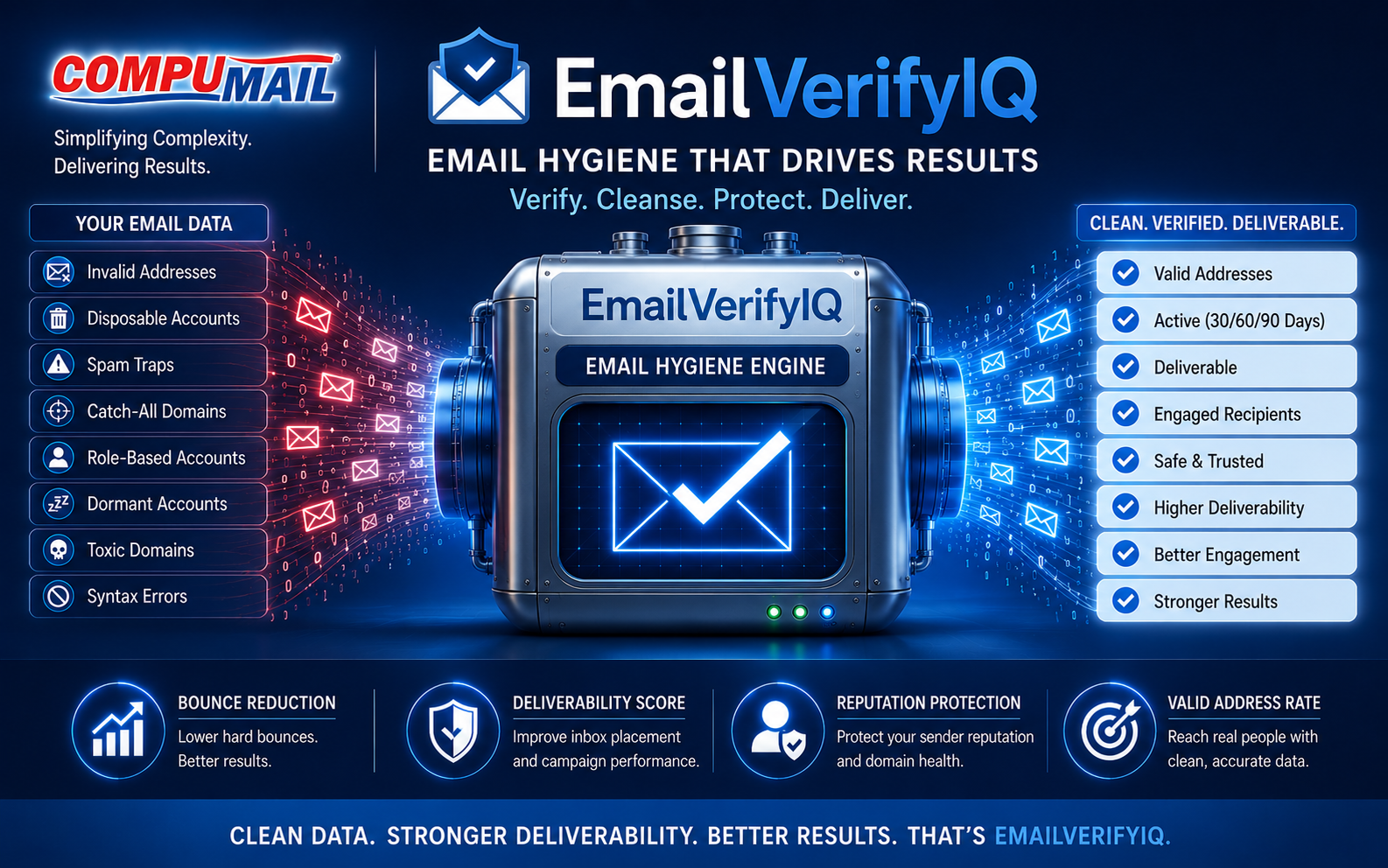
Meet EmailVerifyIQ: Why Email Address Hygiene Matters Just as Much as Address Hygiene
Improve email deliverability, reduce bounce rates, and protect your sender reputation with EmailVerifyIQ. Verify email addresses before deployment and maximize campaign performance.
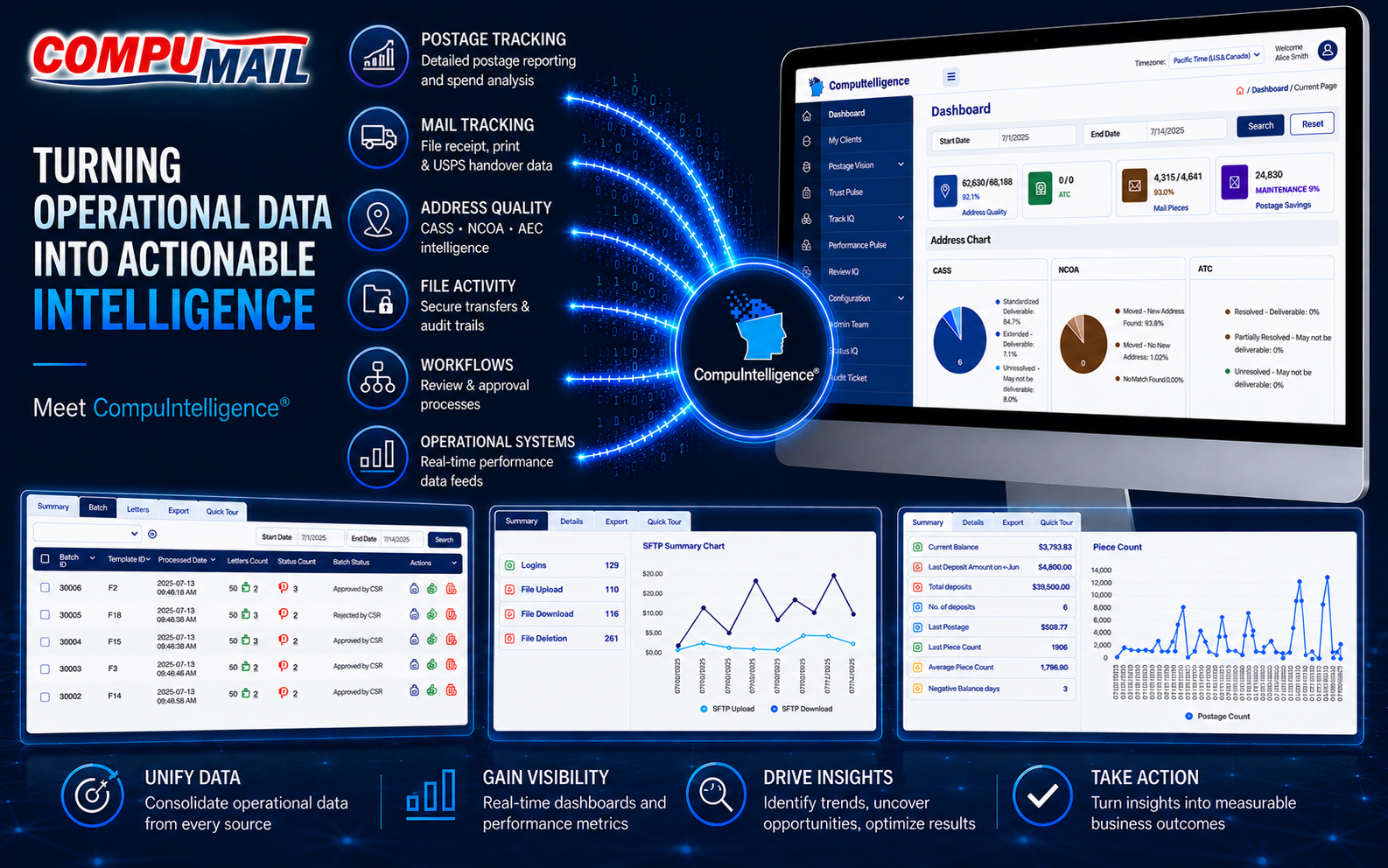
Meet CompuIntelligence® Communication Intelligence & Reporting Platform
In today's business environment, organizations generate more communication data than ever before. Every email, print campaign, SMS notification, compliance review, and consumer interaction creates valuable information.

