Today's email ecosystem evaluates a wide range of signals before and after a message is sent. The quality of your recipient data matters. Your sending history and reputation matter. Authentication matters. Recipient behavior matters. Even when a message arrives can influence whether it gets noticed.


.png)


Sending an email is easy. Getting it delivered, recognized, trusted, opened, and acted upon is much more complicated.
Organizations increasingly rely on email for everything from customer engagement and account communications to important notices and payment reminders. But simply pressing “send” doesn't mean a message will reach its intended audience—or even make it to the inbox.
Today's email ecosystem evaluates a wide range of signals before and after a message is sent. The quality of your recipient data matters. Your sending history and reputation matter. Authentication matters. Recipient behavior matters. Even when a message arrives can influence whether it gets noticed.
And mailbox providers are placing more responsibility on senders.
Google's current requirements, for example, require senders delivering more than 5,000 messages per day to Gmail accounts to use SPF, DKIM, and DMARC authentication, maintain low spam rates, and support one-click unsubscribe for marketing and subscribed messages. Google recommends keeping user-reported spam rates below 0.1% and avoiding rates of 0.3% or higher.
Yahoo has implemented similar requirements for bulk senders, including SPF, DKIM, DMARC, easy unsubscribe capabilities, and spam complaint rates below 0.3%.
The takeaway isn't simply that email has more rules. It's that successful email communication requires organizations to think about the entire journey of a message.
That journey begins well before the email is sent.
1. Start With Better Data
Every email campaign begins with an address.
But is that address still valid? Does the mailbox exist? Is it active? Is it associated with a disposable account, catch-all domain, role-based account, known spam complainer, or another potential risk?
Sending repeatedly to poor-quality addresses can create more than wasted volume. It can contribute to hard bounces and other signals that affect sender reputation and future deliverability.
Google's own guidance recommends confirming recipients' email addresses and periodically evaluating whether recipients still want to receive messages.
That's why email hygiene should happen before deployment, not simply as a reaction to bounce reports afterward.
Where EmailVerifyIQ fits
CompuMail's EmailVerifyIQ analyzes email addresses before deployment to help organizations identify valid, invalid, dormant, temporary, disposable, role-based, catch-all, and other potentially problematic addresses.
The goal is simple: send smarter from the beginning.
Cleaner email data can help organizations reduce hard bounces, protect sender reputation, improve the likelihood of inbox placement, and avoid spending resources attempting to communicate with addresses that are unlikely to deliver.
But clean data is only the first piece.
2. Build and Protect Your Sending Reputation
Mailbox providers don't evaluate each email in isolation.
They also evaluate the sender.
Domain reputation, IP reputation, authentication, complaint activity, sending patterns, and other signals can influence whether messages reach the inbox, land in spam, or are rejected altogether.
This becomes particularly important when an organization introduces a new domain or IP address, resumes activity on a dormant one, or significantly changes its sending volume.
Rather than immediately sending at full volume, a controlled warm-up process gradually establishes sending activity. Consistency matters: sudden spikes or irregular patterns can create unnecessary risk.
Where InboxOptimizer fits
InboxOptimizer is designed to support domain and IP warm-up by gradually establishing sending volume and consistent sending patterns. It also monitors factors such as bounce rates, spam complaints, and engagement levels so the warm-up strategy can be adjusted as needed.
Think of it as establishing a track record before asking mailbox providers to trust you with significant volume.
That reputation isn't built once and forgotten. It has to be protected through good data, responsible sending practices, authentication, monitoring, and continued engagement.
3. Make It Clear Who the Message Is From
Reaching the inbox is important.
Being recognized once you're there is another challenge.
Recipients scan crowded inboxes quickly. A recognizable and authenticated sender can help distinguish a legitimate communication from an unfamiliar—or potentially fraudulent—message.
That's where Brand Indicators for Message Identification (BIMI) enters the picture.
BIMI allows a sending domain to publish a logo that participating mailbox providers can display alongside authenticated email. Importantly, BIMI isn't itself an email security solution. It builds on established authentication practices, including DMARC.
The BIMI Group currently requires organizations implementing BIMI to authenticate email with SPF, DKIM, and DMARC, with DMARC at an enforcement policy of quarantine or reject.
Where InboxIdentity fits
CompuMail's InboxIdentity helps organizations navigate BIMI implementation, including logo preparation and verification, DNS configuration, DMARC alignment, implementation support, and ongoing monitoring.
The result is another layer in the email experience: recipients can more readily associate a message with the organization that sent it.
It's an important distinction. Deliverability gets you into the inbox. Identity helps people recognize you once you're there.
4. Deliver at the Right Time
You've validated the address.
You've built your sending reputation.
You've authenticated the message and strengthened your identity.
There's still another question:
When should the email arrive?
An email delivered at 9:00 a.m. Pacific Time reaches someone in New York at noon. A nationwide audience can span several time zones, meaning a single deployment time doesn't necessarily create a consistent recipient experience.
For organizations communicating across large geographic footprints, delivery timing can therefore become another part of the communication strategy.
Where SmartSend fits
SmartSend enables email delivery based on the recipient's local time zone rather than treating the entire audience as if they're in the same place.
The service can automatically detect recipient time zones and schedule delivery accordingly, while also supporting customizable schedules and performance reporting.
Instead of asking, “What time should we send this campaign?” organizations can ask a better question:
“What time should each recipient receive it?”
That subtle change puts the recipient experience at the center of the deployment strategy.
Email Performance Is an Ecosystem
There isn't one switch that guarantees inbox success.
Good email performance is the result of multiple disciplines working together.
Data quality helps ensure you're communicating with valid recipients.
Sender reputation helps mailbox providers understand and trust your sending behavior.
Authentication and identity help establish who you are and make legitimate communications easier to recognize.
Delivery timing helps ensure the message arrives when it's more likely to be relevant to the recipient.
Each one addresses a different point in the email journey. And weaknesses in one area can undermine work being done elsewhere.
A perfectly timed email doesn't matter if the address is invalid. A clean address doesn't guarantee inbox placement if the sender has poor reputation. And reaching the inbox provides limited value if recipients don't recognize or trust the sender.
That's why organizations should look beyond individual email campaigns and evaluate their overall email communication infrastructure.
A More Complete Approach to Email
CompuMail helps organizations manage that broader email journey through four complementary services:
EmailVerifyIQ helps improve the quality of the data before deployment.
InboxOptimizer helps establish and protect the sending reputation behind the message.
InboxIdentity helps strengthen authentication, brand recognition, and visibility in supported inboxes.
SmartSend helps optimize when communications reach recipients.
Together, they provide organizations with a more comprehensive approach to email—from the quality of the address to the moment the message reaches the recipient.
Because successful email communication isn't simply about sending more messages.
It's about giving every message a better opportunity to reach the right person, in the right inbox, from a sender they recognize, at the right time.
Ready to Take a Closer Look at Your Email Strategy?
Whether you're focused on improving data quality, strengthening sender reputation, increasing brand visibility, optimizing delivery timing, or evaluating your overall email program, CompuMail can help.
Request a demo to learn how CompuMail's email solutions can support a smarter, more effective communication strategy.
Latest insights from our articles
Explore a collection of curated articles designed to help you stay ahead in multichannel communication, compliance, and digital transformation.
Getting to the Inbox: The Four Building Blocks of Better Email Performance
.png)
From Blind Spots to Insights: Why Visibility Matters!
Learn how better visibility into production activity, postage spend, address quality, communication workflows, and file activity can help organizations uncover trends, identify issues earlier, and turn communication data into actionable business insights that support smarter decisions.
.png)
What Could You Do With 27% More Space on Your Mailpiece?
Moving from letter-size to legal-size paper creates approximately 27% more content area—opening new opportunities for calls to action, QR codes, regulatory content, and smarter document design.
.png)
Security Isn't a Feature. It's the Foundation.
Whether it's a billing statement, healthcare notice, collection letter, or account notification, organizations are responsible for protecting sensitive consumer information at every stage of the communication lifecycle. That responsibility extends far beyond simply delivering a document.
.png)
A Gold Glove Customer Experience: Precision, Partnership, and Proactive Service from End to End
Baseball fans love the highlight-reel plays. The diving stop, the throw from deep in the hole, the game-saving catch. Those moments earn applause. But ask any coach what wins championships, and the answer is different.
.png)
Don't Leave a Runner on Base: How Address Hygiene Improves Delivery Rates and Reduces Waste
In baseball, getting runners on base is only half the battle. The teams that consistently score are the ones that capitalize on every opportunity instead of leaving runners stranded.
.png)
The Rise of the Phygital Consumer: Why Print, Email, and SMS Work Better Together
Discover why today's consumers respond best to integrated print, email, and SMS communication strategies. Learn how omnichannel engagement improves visibility, response rates, consumer experience, and business outcomes.
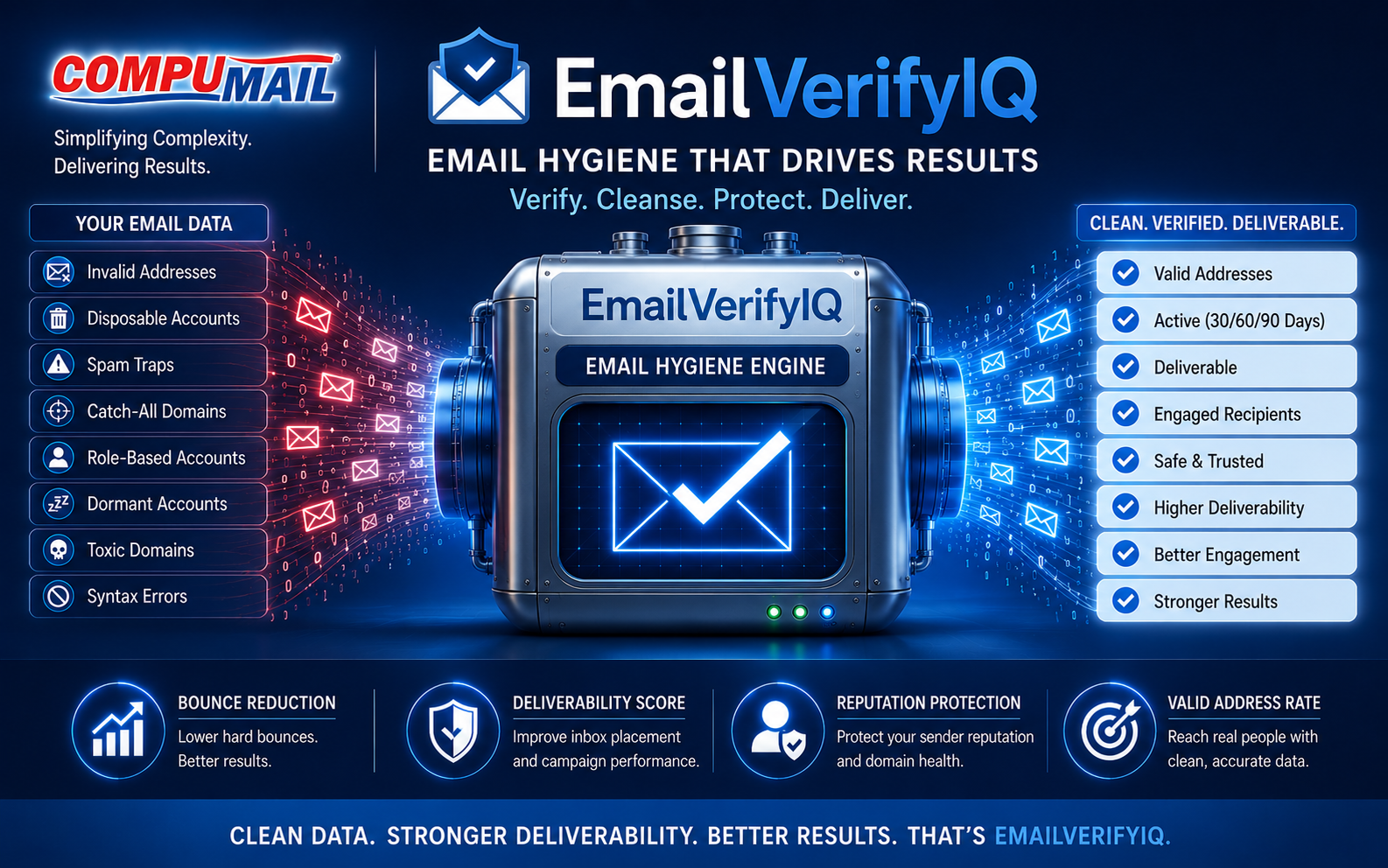
Meet EmailVerifyIQ: Why Email Address Hygiene Matters Just as Much as Address Hygiene
Improve email deliverability, reduce bounce rates, and protect your sender reputation with EmailVerifyIQ. Verify email addresses before deployment and maximize campaign performance.
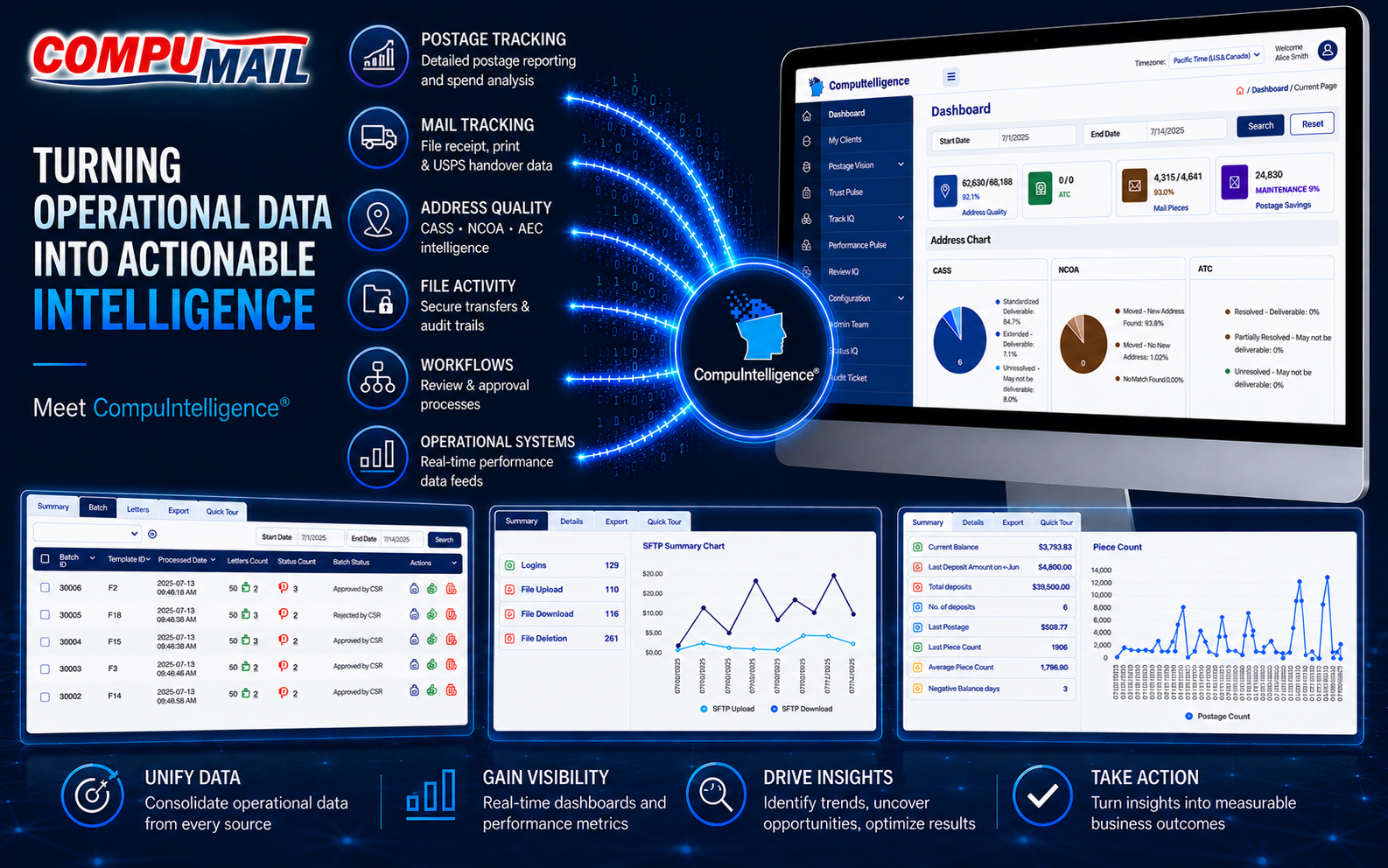
Meet CompuIntelligence® Communication Intelligence & Reporting Platform
In today's business environment, organizations generate more communication data than ever before. Every email, print campaign, SMS notification, compliance review, and consumer interaction creates valuable information.

